
No products
Product successfully added to your shopping cart
There are 0 items in your cart. There is 1 item in your cart.
Catalog

Wishlist
New products
-

Hand Chain "Italian Bracelet with a 4 cm Bar Plate"
Silver chain on the hand Silver bracelet with a plate on which you can...
109,00 € -

Natural copper bracelet - thin double chain
Jewellery Copper chain - bracelet made of pure copper.Copper chains...
40,00 €
Specials

Silver rings with stones
-
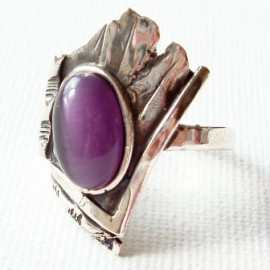 Price 63,90 €
Ring with Purple Cat's Eye Ž054 Ring with Purple Cat's Eye Ž054
0 Review(s)Silver ring A ring of unseen and beautiful design. Adorned with purple stone - synthetic Cat's Eye. The ring is composed with a pendant of this style. Silver ring A ring of unseen and...
Online only -
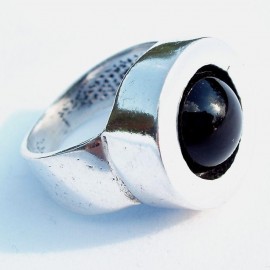 Price 85,00 €
Ring with Onyx Ž080 Ring with Onyx Ž080
1 Review(s)Silver ring Gorgeous and stylish, with inlaid black Onyx. Smooth polished surface. The stone is natural Onyx. Ring diameter (circle) -17 mm. Silver ring Gorgeous and stylish,...
Online only -
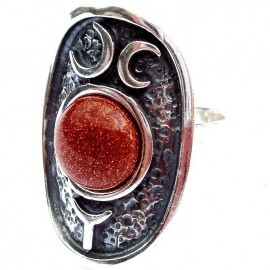 Price 86,00 €
Ring with Sunstone Ž059 Ring with Sunstone Ž059
0 Review(s)Silver ring Beautiful and comfortable, fitting ring on the finger of the handStone - Aventurine (sun stone). Silver ring Beautiful and...
Online only -
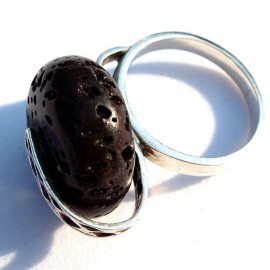
Ring with Lava Ž103 Ring with Lava Ž103
0 Review(s)Silver ring Lava, originally and precisely placed in a silver ring.Lava, it’s an erupting volcanic magma. In its structure, one can see the lava flow, the rock concentration.Ring size - 17 mm. Silver ring Lava, originally and...
-
 Price 76,00 €
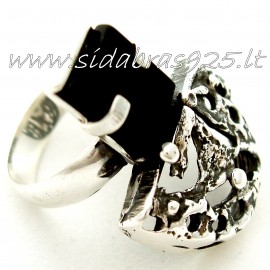
Ring with a rectangular s.Onyx Ž506 Ring with a rectangular s.Onyx Ž506
0 Review(s)Silver ring Special designs for those who want to stand out, for those who love themselves - for women! The ring is decorated with a flat stone of s.Onyx. Careful design that combines plastic semi-precious silver and black Onyx. A wonderful, breathtaking set created: earrings and a large pendant Ring size - we will make the required size to order. Feel... Silver ring Special designs for those...
Online only -
 Price 75,00 €
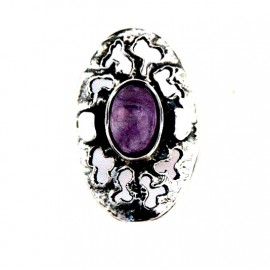
Ring with Amethyst Ž492 Ring with Amethyst Ž492
0 Review(s)Silver ring Amethyst, the stone of lovers, protects against spells, did not allow intoxication from alcohol. Due to its magical powers it was considered the stone of the bishops. It also maintains the body's balance, eliminates headaches, fatigue, strengthens memory, improves intestinal and kidney function. If, you intuitively choose this stone, it is... Silver ring Amethyst, the stone of...
Online only -
 Price 140,00 €
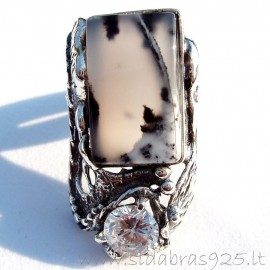
Ring with Agate and ZirconiumŽ422 Ring with Agate and ZirconiumŽ422
2 Review(s)Silver ring Exclusive jewelry with natural agate of impressive beauty.A massive, elongated ring will adorn your hand.Comfortable to wear, visually lengthens fingers.Stone - Landscape Agate (each stone is original), has a unique image, which gives it uniqueness.The ring is also decorated with Zircon. Silver ring Exclusive jewelry with...
Online only -
 Price 79,00 €
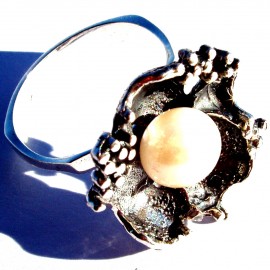
Ring with Perl "Gėlė" Ž116 Ring with Perl "Gėlė" Ž116
0 Review(s)Silver ring Collection of Natural Pearls. An ornate ring is like a flower, with a large white pearl in the middle.A wide set of jewelry of this style has been created: ring, earrings, pendant, bracelet, necklace.The high-quality collection will decorate everyone! Ring size - we can produce the desired size. Silver ring Collection of Natural...
Online only -
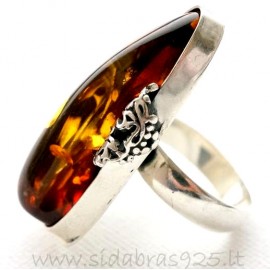 Price 0,00 €
Unique jewelry ring with Amber Unique jewelry ring with Amber
0 Review(s)Silver unique jewelry Silver unique jewelry
Online only -
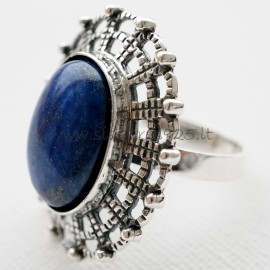 Price 90,00 €
Ring with Lazurite "Dangiškuoju akmeniu " Ž540 Ring with Lazurite "Dangiškuoju akmeniu "...
3 Review(s)Silver ring Fantastic Jewelry With Lazurite Stone.It is a stone of renewal, giving energy to those who seek innovation, strive to break out of the routine, eager to implement new plans, reach heights. It helps to find like-minded people, and it is also a stone of truth and friendship.We made earrings and a pendant in the collection.When ordering the set,... Silver ring Fantastic Jewelry With...
Online only -
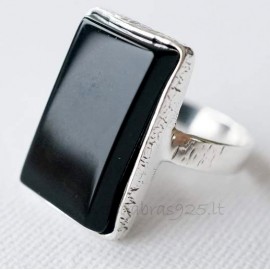 Price 44,00 €
Ring with Onyx Ž611 Ring with Onyx Ž611
0 Review(s)Silver ring It just exudes elegance. Classic ring with a smooth rectangular stone Onyx. Silver 925. Jewel - Onyx Ring width - 23 mm x 16 mm. Silver ring It just exudes elegance....
Online only -
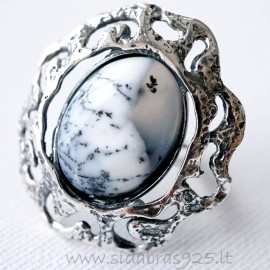 Price 89,00 €
Ring with landscape Agate "Sun Petals" Ž470-2 Ring with landscape Agate "Sun Petals" Ž470-2
0 Review(s)Silver ring Impressive beauty jewelry with natural Agate.An oval, artistically designed ring will adorn each style.Tall but comfortable to wear.For those who like outfits, we created earrings.Stone - Landscape Agate (each stone is original), has a unique image, which gives it uniqueness. Silver ring Impressive beauty jewelry...
Online only
Silver rings with stones
We produce high-quality 925 sterling silver rings with stones. Here are the ones that have become our customers’ favorites:
- silver rings with zircon
- silver rings with onyx
- silver rings with lapis lazuli and other various colored stones.
What are the most popular stones in silver rings and how to choose yours?
The most popular choices among our customers are onyx and zircon due to their versatility and elegance.
We noticed that our customers especially like natural stones: onyx, agate, pearl and other unique minerals in bright colors. Such silver rings with stone attract with their natural patterns, real color – such a jewelry automatically becomes unique due to the distinctive, non-repeating stone.
In addition, jewelry with stones is worn as healing and mystical minerals - each stone has its own meaning and vibrates, emitting its own unique energy. They can be chosen according to zodiac signs.
Find out how to distinguish a real stone from a fake one?
Most buyers do not know what they are wearing, here are simple ways to distinguish a real natural creation from a laboratory masterpiece created by humans.
- Temperature test (real stone is always cold)
Real - will remain cool even in a warm room and slowly warm up even in the palm of your hand.
Fake (imitation - plastic, glass) heats up instantly from any heat source. - Visual test (nature is never perfect)
Real - inside you will see small cracks, gaps, crystals of other minerals or uneven color. These are natural marks created by nature.
Fake (imitation) - smooth, without cracks, perfectly uniform color. The stone looks too perfect, such should be checked by a gemstone laboratory specialist. - Weight test
Real - heavier. Most gemstones are dense therefore heavy for their size.
Fake (imitation) - plastic will always be suspiciously light, and glass will be slightly lighter than a natural mineral.
All stones – are incorrectly named. We help you understand what you are choosing so that your jewelry will not only please the eyes but also be an honest purchase. In our product descriptions you will always find the name of the stone. If it is a fake stone it will be clearly marked as "imitation".
Here are 4 main stone groups - what kinds of stones are there?
- Natural (real) stones
These are stones created by nature. They are the most valuable because they are rare and unique.
Pay attention, when buying a ring with a larger stone you will have a more valuable piece of jewelry. In nature, the larger the stone, the rarer it is.
Gemstones - the rarest and most expensive. Traditionally this group includes only four main stones:
Diamond - the hardest natural mineral.
Emerald - valued for its unique green color.
Ruby - a red member of the corundum family.
Sapphire - usually blue, but can also be other colors (except red)
Semi-precious stones - natural, but more commonly found (e.g. amethyst, topaz, amber).
- Synthetic (laboratory) stones
It is important to understand that these are not fake or counterfeit, but newly identical minerals, only grown by humans.
They look perfect, properties are the same, but the price is much lower. They are perfect, without natural cracks, because they are created in a laboratory.
They have the same hardness and brilliance as real stones.
They have identical chemical composition and crystal structure as natural stones. Most popular in jewelry are diamonds, rubies, sapphires, emeralds, aquamarine.
Difference - e.g.: synthetic sapphire is a sapphire, only it was not formed in the depths of the earth over millions of years, but grown in a laboratory within a few weeks.
- Reconstructed (composite) stones
These are stones made from “leftovers” of other natural stones. Stone dust or fragments are mixed with glue and pressed - compressed, therefore the whole is made from real stone particles, often colored accordingly, but it is not a single natural creation, therefore it is cheap.
Most often used for turquoise, amber, coral - softer stones. - Imitations (fakes)
These are simply copies of the appearance of a stone, having nothing to do with a real stone. Most commonly used in costume jewelry – they shine nicely but have no lasting value.
They only look like stones but do not have the same chemical properties.
Most commonly: plastic, glass, cubic zirconia – used mainly in costume jewelry.
Stone value – short summary
- Gemstones - gifts of the earth
These are the most valuable, rarest and hardest natural minerals. Traditionally this group includes only four main stones:
Diamond: The hardest natural mineral.
Emerald: Valued for its unique green color.
Ruby: A red member of the corundum family.
Sapphire: Usually blue, but can also be other colors (except red).
- Semi-precious stones - gifts of the earth
This term is considered somewhat outdated today (in modern gemology they are all called “gemstones”), but it is still used to describe stones that are more common than the “big four”.
Examples: Amethyst, topaz, citrine, garnet, turquoise, amber, jade.
Feature: They can be just as beautiful, but their natural deposits are larger, so the price is usually (but not always!) lower.
- Synthetic stones - created by humans
These are laboratory-grown stones. It is important to understand that these are not imitations.
Origin: They have identical chemical composition, crystal structure and optical properties as natural stones.
Difference: A synthetic ruby is still a ruby, but it was not formed in the depths of the earth over millions of years, but grown in a laboratory within a few weeks. They are usually visually more perfect and cheaper than natural ones.
- Imitations and reconstructed stones
This category is for objects that only look like gemstones but are not.
Imitations
These can be glass, plastic or other cheap minerals (e.g. cubic zirconia used in costume jewelry).
Short summary comparison:
| Type | Origin | Chemical composition | Value | |
| Natural | Natural | Natural | High | |
| Synthetic | Laboratory | Identical to natural | Medium | |
|
Factory | Different (glass/plastic) | Low | |
| Reconstructed | Factory | Stone particles + resin | Low/Medium |
Stone as a human: one was born in the fields (natural), the other – in the city (synthetic). Both are human, both materials are the same minerals.
Silver rings with stones
We produce high-quality 925 sterling silver rings with stones. Here are the ones that have become our customers’ favorites:
- silver rings with zircon
- silver rings with onyx
- silver rings with lapis lazuli and other various colored stones.
What are the most popular stones in silver rings and how to choose yours?
The most popular choices among our customers are onyx and zircon due to their versatility and elegance.
We noticed that our customers especially like natural stones: onyx, agate, pearl and other unique minerals in bright colors. Such silver rings with stone attract with their natural patterns, real color – such a jewelry automatically becomes unique due to the distinctive, non-repeating stone.
In addition, jewelry with stones is worn as healing and mystical minerals - each stone has its own meaning and vibrates, emitting its own unique energy. They can be chosen according to zodiac signs.
Find out how to distinguish a real stone from a fake one?
Most buyers do not know what they are wearing, here are simple ways to distinguish a real natural creation from a laboratory masterpiece created by humans.
- Temperature test (real stone is always cold)
Real - will remain cool even in a warm room and slowly warm up even in the palm of your hand.
Fake (imitation - plastic, glass) heats up instantly from any heat source. - Visual test (nature is never perfect)
Real - inside you will see small cracks, gaps, crystals of other minerals or uneven color. These are natural marks created by nature.
Fake (imitation) - smooth, without cracks, perfectly uniform color. The stone looks too perfect, such should be checked by a gemstone laboratory specialist. - Weight test
Real - heavier. Most gemstones are dense therefore heavy for their size.
Fake (imitation) - plastic will always be suspiciously light, and glass will be slightly lighter than a natural mineral.
All stones – are incorrectly named. We help you understand what you are choosing so that your jewelry will not only please the eyes but also be an honest purchase. In our product descriptions you will always find the name of the stone. If it is a fake stone it will be clearly marked as "imitation".
Here are 4 main stone groups - what kinds of stones are there?
- Natural (real) stones
These are stones created by nature. They are the most valuable because they are rare and unique.
Pay attention, when buying a ring with a larger stone you will have a more valuable piece of jewelry. In nature, the larger the stone, the rarer it is.
Gemstones - the rarest and most expensive. Traditionally this group includes only four main stones:
Diamond - the hardest natural mineral.
Emerald - valued for its unique green color.
Ruby - a red member of the corundum family.
Sapphire - usually blue, but can also be other colors (except red)
Semi-precious stones - natural, but more commonly found (e.g. amethyst, topaz, amber).
- Synthetic (laboratory) stones
It is important to understand that these are not fake or counterfeit, but newly identical minerals, only grown by humans.
They look perfect, properties are the same, but the price is much lower. They are perfect, without natural cracks, because they are created in a laboratory.
They have the same hardness and brilliance as real stones.
They have identical chemical composition and crystal structure as natural stones. Most popular in jewelry are diamonds, rubies, sapphires, emeralds, aquamarine.
Difference - e.g.: synthetic sapphire is a sapphire, only it was not formed in the depths of the earth over millions of years, but grown in a laboratory within a few weeks.
- Reconstructed (composite) stones
These are stones made from “leftovers” of other natural stones. Stone dust or fragments are mixed with glue and pressed - compressed, therefore the whole is made from real stone particles, often colored accordingly, but it is not a single natural creation, therefore it is cheap.
Most often used for turquoise, amber, coral - softer stones. - Imitations (fakes)
These are simply copies of the appearance of a stone, having nothing to do with a real stone. Most commonly used in costume jewelry – they shine nicely but have no lasting value.
They only look like stones but do not have the same chemical properties.
Most commonly: plastic, glass, cubic zirconia – used mainly in costume jewelry.
Stone value – short summary
- Gemstones - gifts of the earth
These are the most valuable, rarest and hardest natural minerals. Traditionally this group includes only four main stones:
Diamond: The hardest natural mineral.
Emerald: Valued for its unique green color.
Ruby: A red member of the corundum family.
Sapphire: Usually blue, but can also be other colors (except red).
- Semi-precious stones - gifts of the earth
This term is considered somewhat outdated today (in modern gemology they are all called “gemstones”), but it is still used to describe stones that are more common than the “big four”.
Examples: Amethyst, topaz, citrine, garnet, turquoise, amber, jade.
Feature: They can be just as beautiful, but their natural deposits are larger, so the price is usually (but not always!) lower.
- Synthetic stones - created by humans
These are laboratory-grown stones. It is important to understand that these are not imitations.
Origin: They have identical chemical composition, crystal structure and optical properties as natural stones.
Difference: A synthetic ruby is still a ruby, but it was not formed in the depths of the earth over millions of years, but grown in a laboratory within a few weeks. They are usually visually more perfect and cheaper than natural ones.
- Imitations and reconstructed stones
This category is for objects that only look like gemstones but are not.
Imitations
These can be glass, plastic or other cheap minerals (e.g. cubic zirconia used in costume jewelry).
Short summary comparison:
| Type | Origin | Chemical composition | Value | |
| Natural | Natural | Natural | High | |
| Synthetic | Laboratory | Identical to natural | Medium | |
|
Factory | Different (glass/plastic) | Low | |
| Reconstructed | Factory | Stone particles + resin | Low/Medium |
Stone as a human: one was born in the fields (natural), the other – in the city (synthetic). Both are human, both materials are the same minerals.